Kidrash Tarkaan
The Horse and His BoyKidrash Tarkaan is Aravis’s father, a powerful noble who rules the province of Calavar. His decision to accept Ahoshta Tarkaan’s marriage proposal sets the conflict behind Aravis’s flight in motion: he treats her future as a family arrangement, while she refuses the match and makes her own escape. Although he is not directly encountered in the principal scenes of her journey, his authority shapes both her deception and the danger she faces if found.
Identity and Position
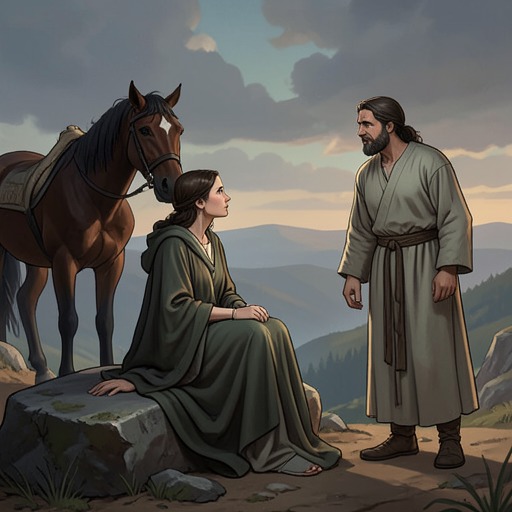
Aravis introduces herself as the only daughter of Kidrash Tarkaan, son of Rishti Tarkaan and grandson of another Kidrash Tarkaan. She traces the family line through Ilsombreh Tisroc and Ardeeb Tisroc, and says that the latter descended in a direct line from Tash. The genealogy presents her father as a member of an established ruling family, not an obscure suitor or provincial outsider.
Kidrash is lord of Calavar and possesses the privilege of standing before the Tisroc in shoes. That detail, offered as part of Aravis’s formal account of her status, locates her household within Calormene courtly hierarchy. Her father’s provincial authority and court standing help explain why Ahoshta’s offer carries political and material weight for him.
The Marriage Arrangement
Kidrash has been widowed and has taken another wife. Aravis says that her stepmother hates her and persuades Kidrash to promise her in marriage to Ahoshta Tarkaan. Ahoshta is described as having risen from low birth through flattery and harmful counsel, winning the Tisroc’s favor and becoming lord of many cities; he may become Grand Vizier when the current holder dies. He is also at least sixty years old. Despite the disparity between them and Aravis’s lack of consent, Kidrash sends messengers with the marriage offer, which Ahoshta accepts for a wedding planned for high summer.
Aravis’s account identifies two immediate influences on Kidrash’s choice: his wife’s persuasion and Ahoshta’s wealth and power. The decision makes the marriage a transaction of family and political advantage rather than a choice made by Aravis. Her distress is severe, but she ultimately counters the arrangement through escape and deception instead of accepting the future her father has selected.
The Permission That Enables Aravis’s Escape
After deciding to flee with Hwin, Aravis returns to her father’s house and pretends to be pleased with the proposed marriage. She asks Kidrash for permission to spend three days in the woods with a maid, claiming that she will perform the customary sacrifices to Zardeenah before marriage. Kidrash grants the request. His consent rests on the explanation Aravis has supplied; he does not know that the journey is a cover for leaving his household.
The permission creates the opening Aravis needs, but her actual plan departs from the one she presents to him. She deceives the household, leaves by night with money, jewels, provisions, armor, and Hwin, and rides north and east toward Tashbaan rather than to the woods. Kidrash’s trust in the stated purpose of her request therefore becomes one of the practical conditions of her flight.
Search and Absence
Aravis says that for more than three days she expects her father not to search for her because he has been misled by her explanation. The delay allows her to get away from the immediate reach of the household. Later, in Tashbaan, her friend Lasaraleen tells her that Kidrash has come to the city and is asking about her everywhere. The revelation changes the nature of Aravis’s situation: her father is no longer merely a distant authority whose plans she has escaped, but an active searcher in the same city where she is trying to remain hidden.
Kidrash’s appearance in Tashbaan also emphasizes the continuing consequences of the marriage conflict. Aravis has not persuaded him to withdraw the arrangement; she has made herself difficult to find. Lasaraleen offers to take her home and hide her because her husband is away, giving Aravis a temporary means of avoiding discovery while her father searches.
Narrative Role
Kidrash is characterized primarily through Aravis’s retrospective account and the reports she receives about him. The evidence shows a father with substantial social standing who accepts a politically advantageous match and grants his daughter’s request without knowing its real purpose. It does not show his private response to her disappearance, his knowledge of the escape, or whether he later changes his position on the marriage.
His narrative importance lies in the contrast between formal permission and actual freedom. Aravis receives leave to undertake a journey, but only by presenting it as a ritual preparation for the marriage he has arranged. Once she is away, the search in Tashbaan confirms that her escape has not ended the family conflict. Kidrash’s decisions thus provide the pressure against which her resourcefulness and determination become visible, while the limits of the account leave his further actions unresolved.